Beyond rising costs: Why Wales needs a new partnership to deliver the next generation of social homes
30 Oct 2026
Development, Partnership news
Working together is going to be vital to delivering the homes our communities need over the coming years.
In this piece written for Welsh Housing Quarterly, Group Chief Executive Richard Mann discusses how the housing sector can work collaboratively to achieve its housing ambitions.
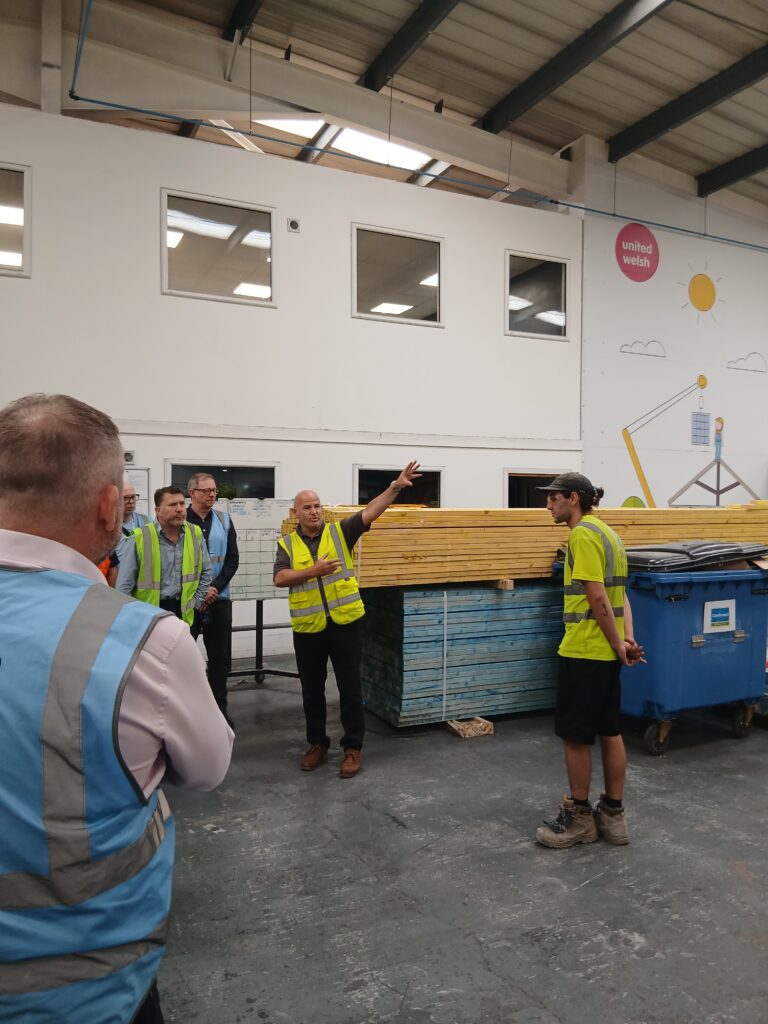
A visit held at Celtic Offsite to discuss the opportunities presented by Tai ar y Cyd
The housing emergency in Wales is often framed as a question of supply.
We know there are too few affordable homes, and demand continues to outstrip availability.
Families are spending longer in temporary accommodation, and communities are struggling to retain affordable homes for local people.
However, there is less discussion about a growing challenge facing the organisations tasked with meeting that need: the rapidly rising cost of building new social homes.
The conversation about rising development costs should be viewed as a catalyst for reform, innovation and collaboration. With a long-term plan, government investment and ambition, Wales has an opportunity to move from housing emergency to housing recovery. That means working collaboratively to build more homes, creating stronger communities and transforming lives.
The economics of social housing development have changed fundamentally over the past decade.
Land values remain high in many locations. Planning obligations continue to increase. Labour shortages affect productivity and cost. Material prices have experienced significant volatility. Decarbonisation standards rightly require better performing homes. Financing costs remain higher than many developers had become accustomed to and the models of delivery are making competition more challenging.
Meanwhile, housing associations are also facing substantial investment requirements to maintain and retrofit existing homes in line with Welsh Housing Quality Standards and net zero ambitions.
Against that backdrop, the ambition to deliver at least 20,000 new social homes by 2030 remains both necessary and challenging. The Welsh Government’s ambition is not in question. Nor is the commitment of housing organisations and local authorities.
The real question is whether the current delivery system can produce the scale and pace of development required.
Increasingly, the evidence suggests a change of approach is needed.
A changing landscape
For many years, development models relied upon a degree of predictability. Construction costs, borrowing costs and land negotiations all moved within relatively understood boundaries.
Today that predictability has largely disappeared.
Development appraisals can change significantly between feasibility and contract award. Cost inflation can undermine scheme viability. Funding gaps emerge later in the development process. Supply-chain issues create delays, compounded by ever-increasing uncertainty around approvals.
We now operate in a system where the process has become more important than the outcome. In some instances, schemes that would have been considered straightforward a few years ago now require extensive intervention simply to remain viable.
The consequence is not simply higher costs. It is reduced certainty, slower delivery and increased risk.
This matters because every pound spent dealing with inefficiency, delay or fragmented delivery is a pound that cannot be invested in additional homes.
Housing associations have demonstrated resilience in adapting to this environment, but this alone will not generate the volume of homes Wales requires.
If we continue to use the same delivery mechanisms while expecting different outcomes, we should not be surprised if housing targets become more difficult to achieve.
When process overtakes purpose
The planning system is perhaps the clearest example. Proper scrutiny of design, safety, environmental impact, transport and community consequences is essential. But safeguards only create public value when they help good schemes reach a sound and timely decision.
When the same scheme moves through repeated rounds of reports, redesign, validation, consultation, conditions and further technical advice without a proportionate improvement in the eventual home, process begins to displace purpose.
That has a direct material cost. Land and finance costs continue to accrue while the scheme produces no homes and no rental income. Inflation can then overtake the original appraisal, forcing redesign, additional grant, a reduced programme or abandonment altogether.
The wider infrastructure system offers a cautionary illustration. HS2 is not directly comparable with a social housing scheme, but it shows how complexity, delay and dependence on specialist advice can become costs in their own right. The lesson is not that consultancy is unnecessary. It is that external advice must remain proportionate, time-limited and visibly connected to decisions and outcomes.
The cost does not stop at the development boundary.
A delayed general-needs home can mean a household remaining in expensive temporary accommodation.
A delayed accessible or supported home can mean someone staying in hospital, residential care or an unsuitable placement because the right housing solution does not exist.
Audit Wales reported in 2025 that demand for temporary accommodation had increased almost five-fold over the preceding decade and that councils were spending considerable sums on provision that often did not meet people’s needs.
Senedd Research reported 1,367 delayed hospital discharges in September 2025 and identified a shortage of appropriate intermediate or step-down care among the persistent challenges. CIH Cymru has also highlighted that a lack of suitable housing affects hospital discharge for older people, people with mental health needs and people who are homeless.
This is why the appraisal of delay must be broader than the development account.
The apparent saving achieved by deferring a decision or asking for one more report can be outweighed by costs elsewhere: temporary accommodation, social care, NHS bed occupancy, crisis support, family breakdown and lost independence.
The cost has not disappeared. It has moved from a capital programme into more expensive, reactive public services, while the person who needs a home continues to wait.
The answer is not weaker planning or lower standards. It is a more disciplined, outcome-led system: clear requirements at the outset, proportionate evidence, parallel rather than sequential consideration, earlier resolution of material issues, and firm ownership of decisions.
The test should be simple: does each stage materially improve the quality, safety, sustainability or deliverability of the homes? If not, it should not be allowed to become an end in itself.
The scale of the challenge
The challenge is particularly significant given the scale of the current ambition.
Delivering 20,000 new social homes by 2030 represents one of the most important housing commitments made in Wales for a generation. It reflects both the urgency of housing need and the recognition that secure, affordable housing underpins wider economic and social outcomes.
Achieving that ambition will require not only funding, but also access to land, planning capacity, construction capacity and a resilient supply chain.
The reality is that no single organisation can solve these challenges alone.
Success depends upon collective action.
That is why the next phase of social housing delivery in Wales should be viewed less as a funding programme and more as a national partnership.
Learning from Tai ar y Cyd
Fortunately, Wales already has a powerful example of what collaboration can achieve.
Tai ar y Cyd was established as a coalition of Welsh social landlords committed to creating a common approach to the design and delivery of high-quality, low-carbon homes.
A visit held at Celtic Offsite to discuss the opportunities presented by Tai ar y Cyd.
The initiative has brought together housing associations and local authorities around shared standards, common house types and standardised designs.
While it still had its challenges, Tai ar y Cyd shows that when we work collectively rather than individually, we can create the scale required to influence markets, support suppliers and reduce unnecessary duplication.
The benefits are substantial. Design costs can be reduced, manufacturing becomes more efficient and delivery can accelerate.
Perhaps most importantly, existing sector resources can be focused on creating homes instead of reinventing processes.
Tai ar y Cyd is about much more than a pattern book. It represents a different way of thinking about delivery and recognises a level of trust in the sector which can be built upon.
It shows how collective leadership can create outcomes that would be difficult for any individual organisation to achieve alone.
UNNOS
While Tai ar y Cyd focuses primarily on housing design, standardisation and supply-chain development, there is an opportunity to apply the same collaborative thinking to the broader development system.
UNNOS has been proposed as a collaborative, land-led delivery model designed to accelerate social housing development, strengthen Welsh supply chains and ensure that value generated through development is retained for social purpose.
At its heart I believe that there is a simple proposition.
Public bodies collectively own significant land assets. Housing associations possess development expertise. Local authorities understand local housing need. Welsh manufacturers and contractors have capacity that could be grown through greater certainty of demand.
However, these strengths are often not connected through a single delivery framework and often duplicate activity.
I believe that UNNOS needs to create that framework.
The concept involves identifying strategic public land opportunities, co-ordinating delivery partners, supporting viability, creating repeatable development processes and strengthening Welsh Modern Methods of Construction supply chains.
It is specifically intended to help overcome some of the constraints currently limiting housing delivery, including land, viability, planning complexity and construction capacity.
But the model is not simply about building more homes.
It is also about driving down cost and retaining more value within Wales.
Too often, public investment can leak out of the Welsh economy through fragmented supply chains or conventional development structures.
By contrast, a collaborative approach can help ensure that economic benefits, skills development and future investment remain connected to the communities they are intended to serve.
From competition to collaboration
The traditional development model often creates competition between organisations pursuing similar objectives.
For example, housing associations compete for land and developers compete for sites.
While competition undoubtedly has a role, the scale of the housing challenge in Wales suggests greater collaboration could now deliver greater value.
This is particularly true where public land is concerned.
If the primary objective is to maximise housing delivery, create social value and achieve public policy outcomes, then success should be measured by the number and quality of homes delivered, not simply by the amount of money generated from individual land transactions, but by overall value.
That requires trust. It requires shared objectives and it requires Welsh Government and housing associations working together in a genuinely strategic partnership.
Time for opportunity
The housing sector is entering a period of transformation.
Digital design, standardisation, MMC, net zero construction and greater collaboration all have the potential to reshape how homes are delivered, reduce cost and increase value.
At the same time, political support for increasing social housing supply remains strong.
The question facing Wales is whether we are willing to match ambitious housing targets with equally ambitious reform of delivery mechanisms.
The answer should be yes.
The sector has already demonstrated through Tai ar y Cyd what can be achieved when organisations come together around a common purpose.
UNNOS offers the opportunity to take that spirit of collaboration a step further, creating a practical delivery vehicle that brings together Welsh Government, local authorities, housing associations and the Welsh supply chain in pursuit of shared objectives, retaining every penny of development potential in the circular economy.
Partnership at the centre
The rising cost of building social homes is a genuine challenge. Ignoring it is not an option. However, neither should it become an excuse for reducing ambition.
Wales needs more affordable homes, not fewer.
The key question is whether we can create a delivery system capable of achieving that ambition in a financially sustainable way.
The solution lies in partnership.
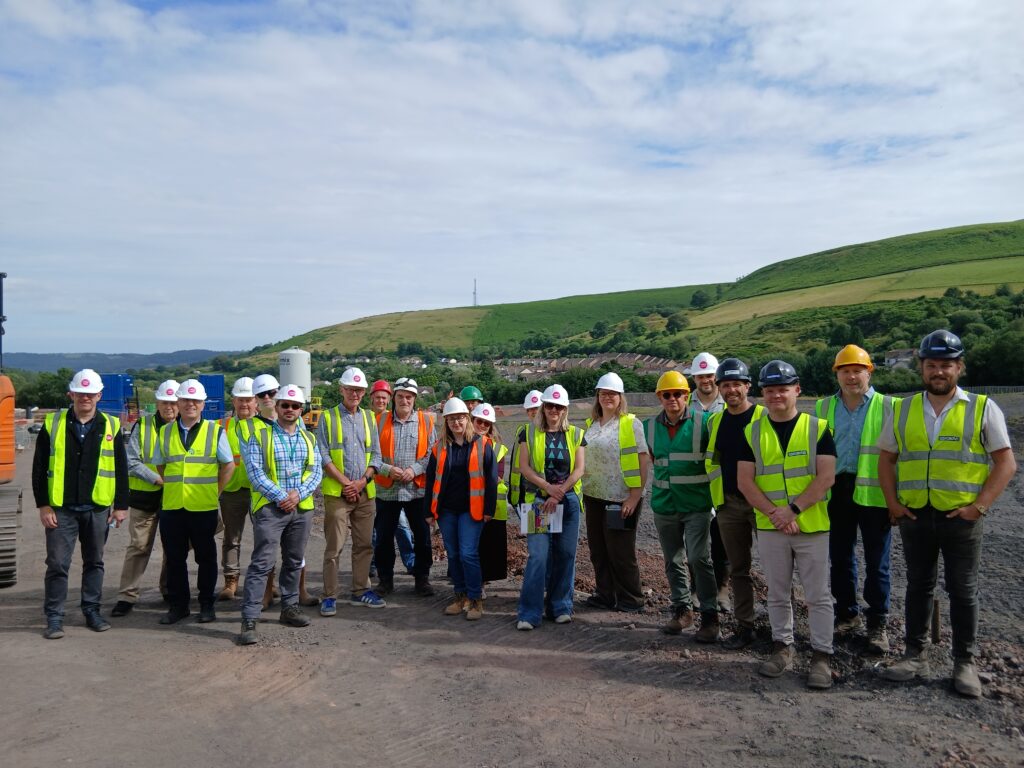
Welsh Government, housing associations, local authorities and the Welsh construction sector all bring unique strengths. If those strengths are aligned around common goals, shared standards and collaborative delivery models, there is every reason to believe that Wales can achieve its housing ambitions.
The lesson from Tai ar y Cyd is that collaboration can work, and the opportunity from UNNOS is to apply that lesson across the development system.
If we get that right, the debate will move beyond rising costs and towards something far more important: building the homes Wales needs, at the scale Wales needs them, while ensuring that the economic and social benefits remain in Wales for generations to come.
The prize could not be bigger. Wales needs thousands of additional social homes. The Welsh Government has signalled a clear ambition to accelerate affordable housing delivery over the coming years.
Achieving those ambitions will require Welsh Government, local authorities, housing organisations and the Welsh supply chain to work together in ways we have not seen before.